


How do you get employees on board with change?

Updated: 7 hours ago
When the plan is fine, but people aren't following it
By Deanne Walsh, Dewa Consulting. Updated October 2026.
Change is something that all businesses face, yet few do well. It is common to have a project plan, Gantt chart, project meetings, issue communications, but rarely do things go smoothly when you run the next staff survey or eNPS (employee Net Promoter Score).
Why do employees resist change even when it's well planned?
It is important to know your people, your team, and their needs.
When it comes to change, not only do we all react differently, but we need to consider
What else is going on for them, both within and outside work
Where are they in the project comms chain?
What is the impact on them? Both perceived and actual
The well known Scott & Jaffe adaptation of the Kubler-Ross curve is useful to understand the processing in relation to workplace change. The important thing to remember is that it isn't necessarily linear and if drawn, would look like Mr Messy at times!
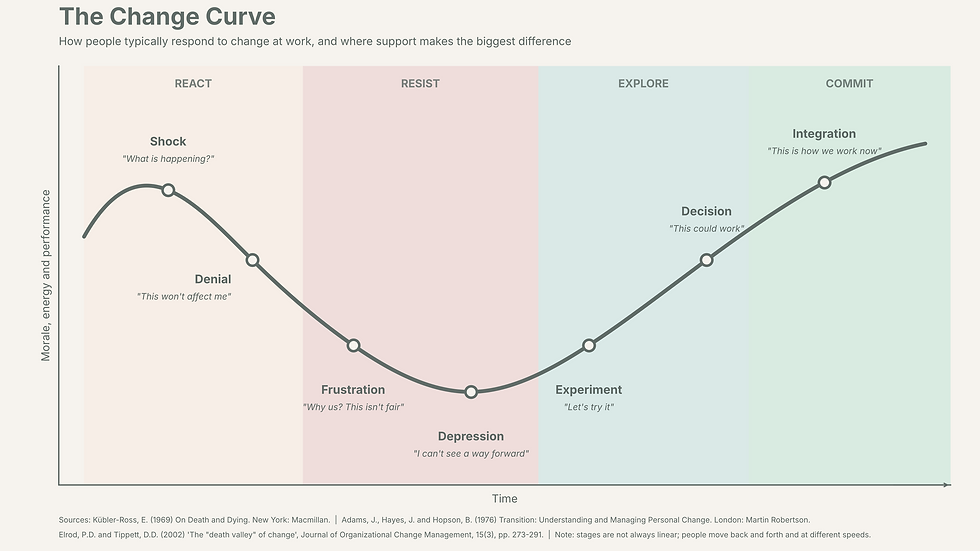
Let's look at the stages:
React - shock & denial - This is a very emotive response, not logical and thought through. It is visceral and hard to control. I have seen this many times in response to redundancy announcements, reactions have ranged from upset to angry and cannot be taken personally
Resist - frustration & depression - This is the time when the news has been processed, the emotions aren't running the show anymore, but the person isn't necessarily on board with the change. Often this stage can come from feeling disconnected or they are negatively impacted and fear kicks in. Consider:
Do they understand what the change is?
Do they understand the reason for the change?
Have their concerns been heard and discussed?
Explore - experiment & decision - This is where people start to accept the change and feel more in control. In experimenting, they are processing what they can and can't live with. At this point you may get more questions about the change and the impact.
Commit - integration - the journey here is that the change has happened, is embedded and is business as usual. There may still be some "wobbles", some regret or resentment for the pre-change way of life, but things are much more settled and predictable.
How do I support my team through change?
What can you do at each stage?
Knowing where someone is on the curve only helps if you change how you respond. What works in one stage can backfire in another.
React: Listen and let people have their reaction. Keep it simple and don't over-explain, because nobody can take in logic while they're in shock. Give them space, tell them when you'll talk again, and make sure you follow through. If someone is really struggling, check in with them one to one and make sure they know what support is available.
Resist: Now is the time to explain. Go back to the why, and be specific about what the change means for them and their role. Ask what's worrying them and take it seriously. Some concerns will point to real problems in the plan, so don't dismiss resistance as people being difficult. It's often the most useful feedback you'll get.
Explore: Give people a chance to try things out and have a say in how the change works day to day. Expect more questions and answer them patiently, even if you've answered them before. Training, time to practise and permission to get it wrong make a big difference here.
Commit: Recognise the effort it took to get here. Thank people, point out what's working, and fix the niggles that are left. Then keep an eye out for anyone who's still stuck further back, because not everyone arrives at the same time.
What Managers need to help the change land.
Managers are usually expected to deliver the change, reassure their team and keep the work going. Often they hear about the change only a day or two before everyone else. They might not agree with it, they might be affected by it themselves, and they're working through their own reaction while being asked to help others through theirs.
Meanwhile, the senior team may have been living with the decision for months. They've worked through the shock and the doubts and they're ready to move on. So when staff react the way anyone would to hearing something for the first time, it gets labelled as resistance. Usually it's just people being at a different point on the same curve.
If you want managers to carry the change well, give them:
A head start. Brief them before their teams, with enough time to take it in themselves.
The why, not just the what. If they can't explain the reason for the change, they can't answer the questions that matter.
Honest answers to the hard questions. Prepare them for what their team is likely to ask, including the questions where the honest answer is "we don't know yet".
Permission to have their own reaction. A manager who has been heard is far better placed to listen to others.
Support for the difficult conversations. Especially where jobs, roles or terms are affected. That includes knowing when to bring in HR and how to spot when someone needs more help than they can give.
A way to feed back. Managers hear what's really going on. Make sure that information reaches the people running the change.
Get your managers on board first and the rest of the plan has a fighting chance.
In Summary: How do I get my team to buy into organisational change?
The simple answer is you talk to them, not once, not just broadcasting, but really explain the change and ask for their thoughts and fears.
Ask how it impacts them.
Ask what they need from you.
Keep them updated.
Give bad news fast.
Don't overshare - being overly transparent can cause panic or fear in some people.
Don't announce publicly before sharing internally. Commercially this can be sensitive, but press releases can go out at the same time as your staff cascade. There is nothing worse than finding out from a news alert about something your employer is announcing.
Tell them what isn't changing, let them anchor onto the familiar.
Train and coach them appropriately.
Don't forget to check in on them as a person, not a worker.
Look after yourself, only then can you lead well.
Finally, don't underestimate the impact of change fatigue. When things are constantly shifting it can be incredibly unsettling and exhausting for everyone involved. Try to maintain some stability and security to retain your valued teams.
About the author
Deanne Walsh is the founder of Dewa Consulting and has worked in HR for 19 years, supporting SMEs through change, restructures and growth. She is a Level 7 qualified Executive Coach and Strategic HR Manager, an MHFA Instructor and a Menopause Champion. Dewa Consulting has trained over 2,000 people in mental health and wellbeing. Deanne won the BIMA People and Talent Award in 2026 and has been featured in i-news and The Women's Journal.
Want support getting your managers ready for the changes? Book a free chat here


Comments