


How do you stop good people leaving during a restructure?

The change is unavoidable, but at what cost?
By Deanne Walsh, Dewa Consulting. Updated October 2026.
Your business needs to change:
Leadership agree
Managers understand
Staff know something is off and the rumours have started
Things can’t go on as they are. You are:
Too expensive / too cheap
Not busy enough
Not selling enough
You get the picture!
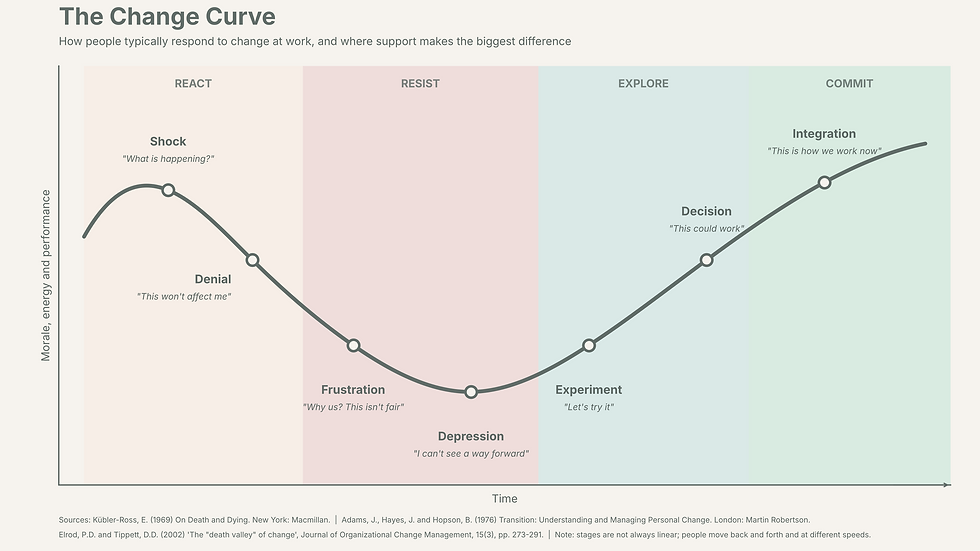
But what happens as soon as those changes are announced?
People become unsettled (according to Gartner, employees’ willingness to support change fell from 74% in 2016 to 43% in 2022, as the number of planned changes the average employee went through rose from 2 to 10).
Change is unnerving. Familiar is comfortable and safe.
Our brains are programmed to feel comfortable with routine – the same people, the same job, the same location, the same commute, the same desk/workstation. These are all tried and tested, which take far less brain power
But losing people, a new way of working, a new building, new responsibilities and suddenly everything feels harder. The brain suddenly needs to work harder, until these things become familiar
Sometimes even change that doesn’t directly impact us will spark fear
“What if this isn’t the last round of redundancies, what if I am next?”
“What if this new process/system is more efficient and I am not needed any more?”
And suddenly the change you are taking them through feels more scary than them making a choice.
Why? Because they control that choice, but the changes that are going on in their “safe space” are totally out of their control
Maybe the change wasn’t well communicated
Maybe their best friend has gone
So our top performers start looking to the job market.
“I might as well see what is out there, I don’t need to move”
They could be approached by head-hunters, who got wind of the change and know that it creates this opportunity for them, whilst our star employees are having a wobble.
Maybe they just feel that this is the kick up the proverbial that they needed to make a change, they had got too comfortable
If you would like additional support helping your team to thrive, book a free chat here
What are the signs that an employee is disengaging?
Increase in sickness absence
Cameras off when dialling into meetings
Working from home more, where the opportunity exists
Not engaging in team meetings
Mistakes in work
Lateness increases
Longer breaktimes are taken
Odd days off at short notice
LinkedIn profile suddenly updated
Not volunteering for projects
Of course, these factors could relate to other things. So without jumping to conclusions, have a conversation. Create psychological safety and encourage honesty and vulnerability, then approach with compassion not just pragmatism.
What can you do to keep people engaged and feeling safe during a restructure?
Communicate, communicate, communicate
You have to be clear on what you are doing and why. People will need to know. Tell them the implications of not doing it and the benefits of doing it.
Be clear, concise and consistent.
Consult. Whether it is a union, an employee representative or 1:1, you need to know how they are feeling, what they need from you and what the impact is of the change. There may be legal implications in redundancy situations, so do take advice before starting any major restructure process.
Check-in. Before, during and beyond the change, make your team feel seen and heard. This is your chance to stabilise them and reassure them of the safety they so desperately need.
Know who you can’t afford to lose and discuss with them early and regularly. Be as clear as you can about where they could fit, without promising outcomes before the process is concluded.
Hold “stay” meetings. When checking in, ask them what would make them stay and most importantly what could tempt them to leave.
Involve your best people in the construction of the new world. Give them a project, make them feel valued and allow them to have some control over how the new world works.
Get to certainty as quickly as possible. It is less stressful to know a negative outcome than to worry about the outcome.
Train or coach your managers. They are at the coalface, hearing the rumours, having the difficult conversations, answering the questions. They need to be prepared and have accurate information cascaded to them.
Don’t promise what you can’t deliver. It may reassure people in the short term if you tell them that this restructure will be the only one. If there is a second and a third, you have lost all trust. Honesty builds more trust than uncertainty.
Look after the “survivors”. You can’t go through a restructure, then go back to “normal”, that doesn’t exist anymore. You can’t suddenly start spending – they will see that spend as the price of the colleague who has just lost their job. It takes time to rebuild trust, so nurture them during this time.
And don’t forget to look after yourself too, nobody leaves this process unscathed.
If you would like to discuss how I can help, book a free chat here
About the author
Deanne Walsh is the founder of Dewa Consulting and has worked in HR for 19 years, supporting SMEs through change, restructures and growth. She is a Level 7 qualified Executive Coach and Strategic HR Manager, an MHFA Instructor and a Menopause Champion. Dewa Consulting has trained over 2,000 people in mental health and wellbeing. Deanne won the BIMA People and Talent Award in 2026 and has been featured in i-news and The Women's Journal.

Comments